
From Chat to Checkout
How agentic commerce is rewriting the rules of online shopping

In a previous CxAI analysis of where ChatGPT wins and loses, we flagged shopping as a category ripe for disruption. It is still under-represented in consumer AI usage today, but has enormous potential as agents become more capable.
This post digs into what happens when AI doesn’t just help you search what to buy, but actually buys it for you. And for that we collaborated with Jamie Seedhouse, a product leader with 20+ years experience transforming some of the UK’s leading ecommerce and marketplace platforms, including eBay, Gumtree and Screwfix. Jamie, welcome to the CxAI team!
AI Has Already Changed Consumer Behaviour
First, some context on just how fast things have moved and are moving.
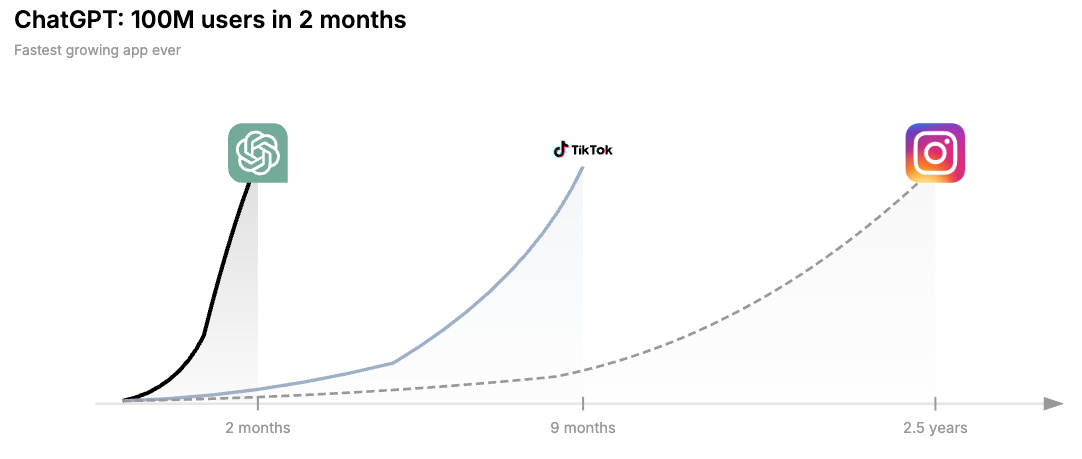
ChatGPT was launched just over 3 years ago and reached 100 million active users in 2 months, making it the fastest growing consumer application in history. By comparison, TikTok took 9 months and Instagram took 2.5 years.
Today, ChatGPT alone has over 800 million weekly users and processes more than 2 billion prompts per day. We’ve never seen consumer adoption at this rate before. As a result, we’re now seeing fundamental shifts in consumer behaviour, particularly around shopping and commerce.
AI is now routinely being used to aid product search through AI assistants or via “AI overviews” rather than browse through Google results pages surfacing in over 50% of searches since mid last year. Consumers are increasingly turning to AI for everything from top-of-funnel discovery (learning broadly about categories, brands and products) all the way to mid-funnel consideration (explaining technical features or specifications) and ultimately supporting the final decision to purchase.
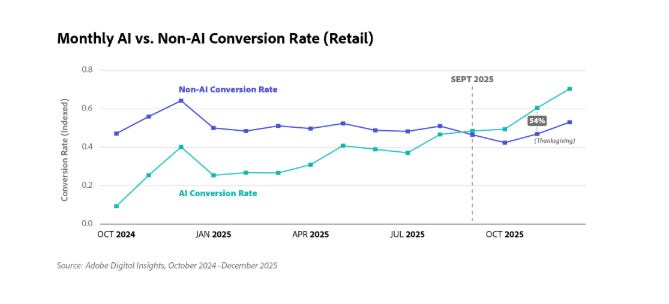
The numbers behind this shift are remarkable. Traffic to U.S. retail sites from generative AI sources surged almost 700% year-on-year during the 2025 holiday season (although the user base is still low, the uptick shows the value AI can deliver in the shopping experience). And this traffic seems to be converting a lot higher. Particularly around key events, like Thanksgiving and Black Friday the conversion gap between AI and non-AI widened as shown by the Adobe chart below.
The Next Big Transformation: Agentic Commerce
The next transformation which is already underway is agentic commerce: AI assistants that don’t just help you think about what to buy, but actually complete the purchase on your behalf, autonomously, without you needing to visit a website, fill out a form, or enter your card details.
As we explored in our earlier series on AI agents, agents are systems that can independently take action and accomplish tasks on your behalf. Until recently, that meant things like drafting emails or researching topics on the web. Now, it means shopping.
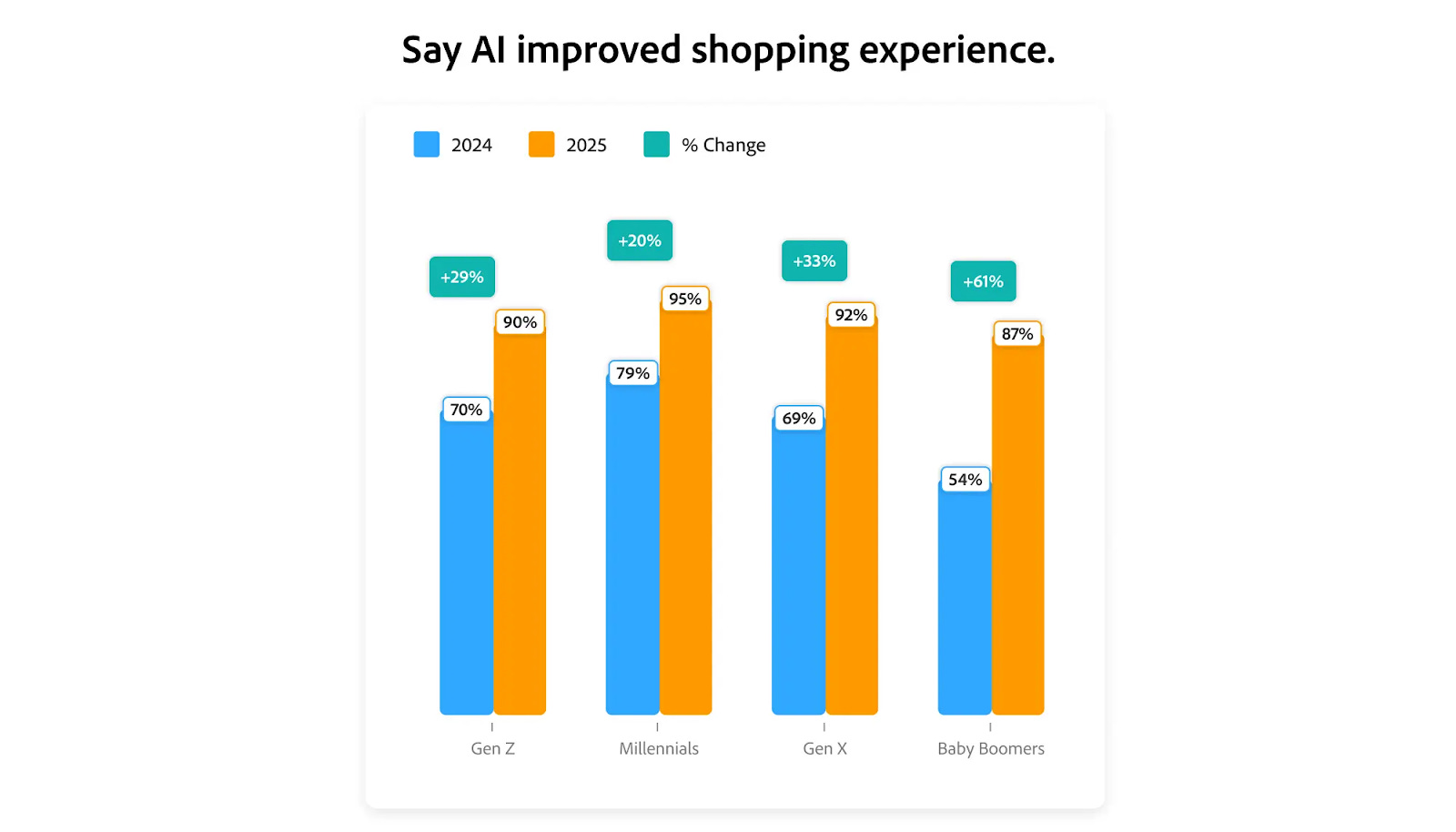
And what is interesting is that so far everyone loves it across all demographic cohorts:
Source: Adobe report from early 2025 showing that people enjoy using agents for shopping
And partly due to this cross-generational appeal, its growth projections are massive:
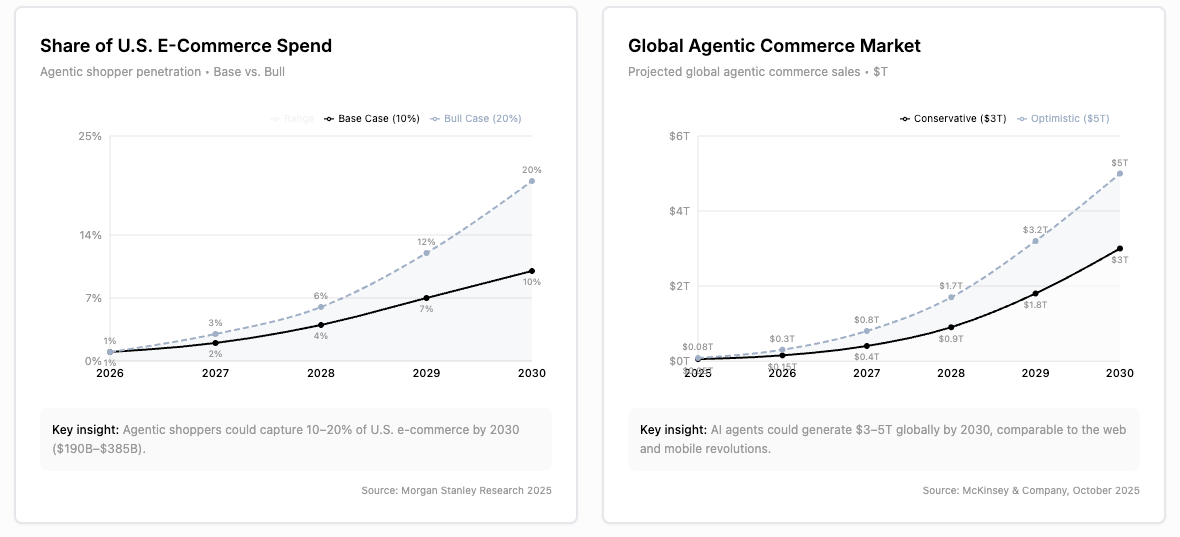
McKinsey projects agentic commerce could drive $3–5 trillion in global orchestrated revenue by 2030. And Morgan Stanley estimates $190–385 billion in U.S. e-commerce spending could be agent-mediated within the same timeframe (reaching between 12% and 20% of US e-Commerce spend)
McKinsey makes a compelling argument for why this could unfold faster than previous digital transformations: AI agents operate along the same digital pathways as human users. They can “ride the rails” of existing commerce infrastructure rather than waiting for entirely new ones to be built. Unlike the shift from physical to online retail which required warehouses, logistics networks and payment gateways to be constructed, agents can work with what already exists.
Unlike blockchain, agentic commerce doesn’t ask consumers to learn new concepts or change payment flows, it quietly plugs into existing apps and checkout journeys to make them feel smarter and more personalized. Whereas blockchain attempts to replace core rails and agents simply optimize what already works, which makes mainstream adoption far more likely.
The Stage Is Being Set
As a result, big players are locking and loading. The race is on, and the biggest platforms are quietly assembling the infrastructure arsenal required to make agentic commerce work reliably and at scale.
Here’s a snapshot of who’s doing what:
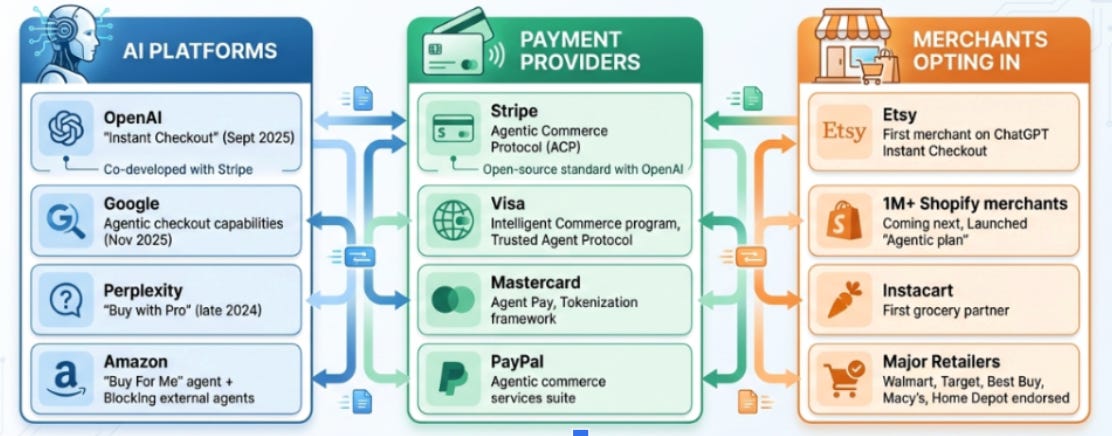
AI platforms are leading the way. OpenAI launched “Instant Checkout” in ChatGPT in September 2025, co-developed with Stripe but only available in the US for now. Google followed with its own agentic checkout capabilities in November. Perplexity had already been there since late 2024 with “Buy with Pro“. Amazon, characteristically, is playing both offence and defence blocking external AI agents from its platform while simultaneously building its own, including “Buy For Me,“ an agent that purchases products from other retailers’ websites within the Amazon app.
Payment providers are building the rails. This is where it gets really interesting. Stripe co-developed the Agentic Commerce Protocol (ACP) with OpenAI as an open-source standard that lets AI agents securely interact with merchants to complete transactions. Visa launched its “Intelligent Commerce” program and introduced Trusted Agent Protocol, an open framework that helps merchants distinguish between legitimate AI agents and malicious bots. Mastercard released Agent Pay with its own tokenisation framework for securing agent-initiated payments. PayPal launched a suite of agentic commerce services. These aren’t press releases about future plans. These are live products being deployed now.
Merchants are opting in. Etsy was the first merchant to go live on ChatGPT’s Instant Checkout. Over a million Shopify merchants are coming next. Instacart became the first grocery partner. Walmart, Target, Best Buy, Macy’s, The Home Depot and many others have endorsed one or more of the emerging protocols. Shopify has gone all-in, launching a dedicated “Agentic plan” and co-developing the Universal Commerce Protocol (UCP) with Google, an open standard designed to make agentic commerce work consistently across different platforms and AI assistants.
The Protocol Wars Have Begun
There are now a growing number of competing open standards jostling for position including AP2 which is an extension to A2A (Google), UCP (Shopify/Google) and Anthropic’s MCP or Model Context Protocol, which standardises how AI agents discover and use APIs. This is in addition to ACP (OpenAI/Stripe), Trusted Agent Protocol (Visa) and Agent Pay (Mastercard) we mentioned above. This “protocol wars” situation mirrors the early web standards battles. The Linux Foundation has established an Agentic AI Foundation with Anthropic, Google, Microsoft and OpenAI as partners which may help resolve the fragmentation. But for now, the ecosystem is assembling fast even if the standards are still being sorted out.
A recent O’Reilly post suggests eventual consolidation around a core protocol stack for agentic eCommerce: i) MCP for tool/data access, ii) ACP for context exchange, and iii) A2A for inter-agent coordination. The key gap O’Reilly highlights is around governance (an ‘Agent Treaty’ layer) rather than another protocol.
Already Here, But Still Early Days
Despite all of this, we should be clear about where things stand today. Agentic commerce is real, but it is at a very early stage of development. ChatGPT’s Instant Checkout is currently limited to the US market and single-item purchases. Only a handful of merchants are live.
We tested the new in-chat shopping flow using a VPN, and the experience was remarkably straightforward. When ChatGPT recommends a product from a merchant integrated via OpenAI’s Agent Commerce Protocol (ACP), a Buy button appears directly inside the chat. You can select options like size or color, enter your shipping address and payment details (which are saved for future orders), and see taxes automatically applied based on your location. Clicking Buy instantly creates the order, and within seconds ChatGPT displays a confirmation with full details.
Behind the scenes, the transaction is processed by the merchant platform (in our case Etsy) which acts as the Merchant of Record, meaning Etsy charges your card, handles taxes, and manages fulfillment. ChatGPT simply acts as the interface layer, allowing you to complete the entire purchase without leaving the conversation. Once you order, ChatGPT shows the order status and provides a “View on Etsy” button so you can track, manage, or cancel the order directly on Etsy, with status updates reflected back inside the chat. In our experience the checkout process is very smooth, comparable to shopping on Amazon.
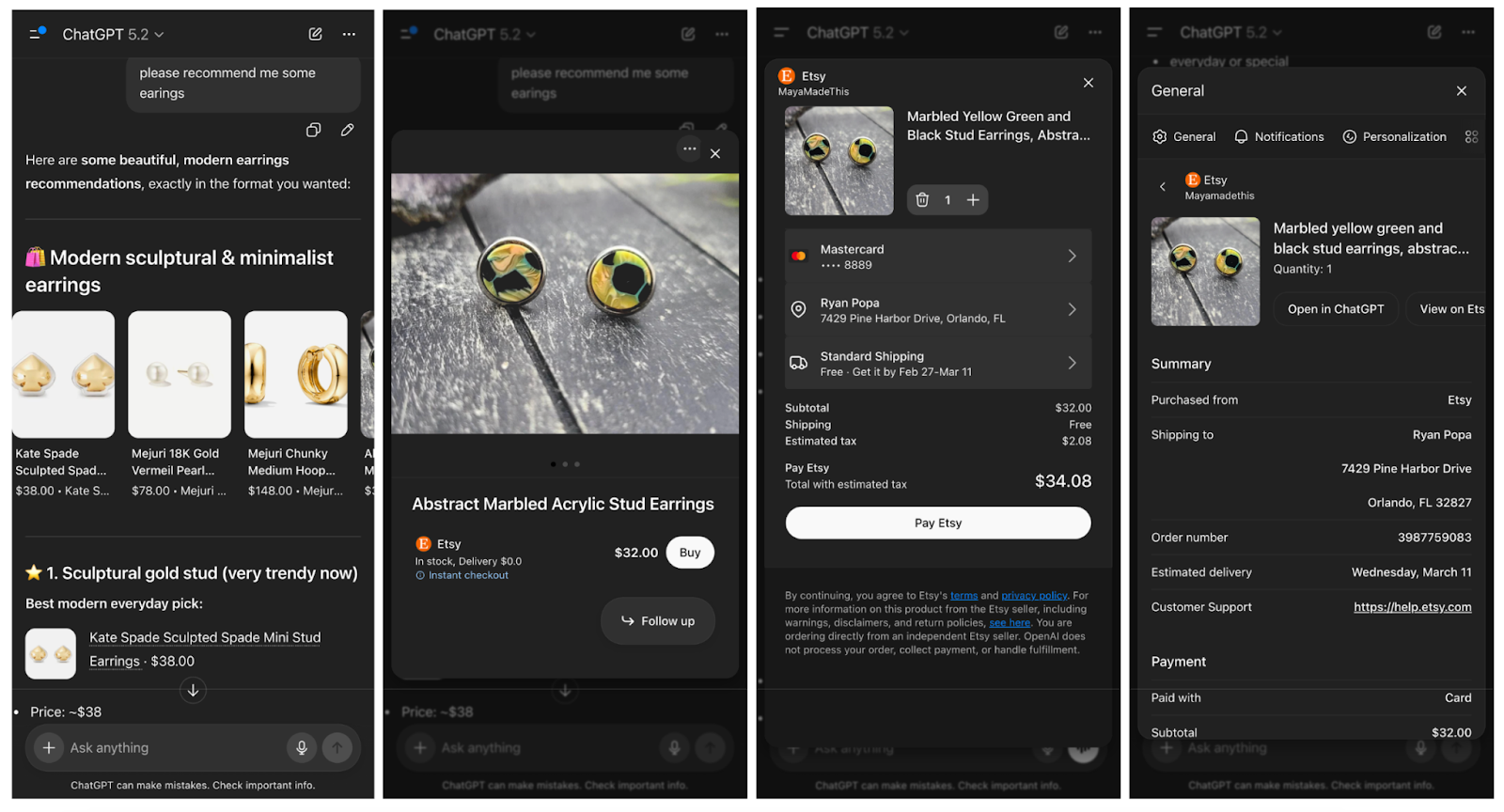
Example checkout inside ChatGPT using ACP
But it really is early days, when OpenAI studied around 1.1 million ChatGPT conversations, just 2.1% of activity was classified as relating to purchasable products. Over Thanksgiving weekend, ChatGPT referrals to e-commerce apps represented less than 1% of all sessions.
We also tested Perplexity’s Comet browser and asked to do something simple: find a specific pair of headphones and add them to the basket on both Argos and John Lewis.
The results were... humbling. In both cases the agent struggled to understand and navigate the sites. In the case of John Lewis, it eventually gave up entirely even though the product was right there. The agent could see the page, but couldn’t reliably interact with it.
Additionally, because not all merchants currently support Instant Buy on Perplexity, the shopping journey feels fragmented. The inconsistency makes it unclear which products can be purchased natively within the Perplexity experience and which require users to leave the platform and complete their transaction on an external site.

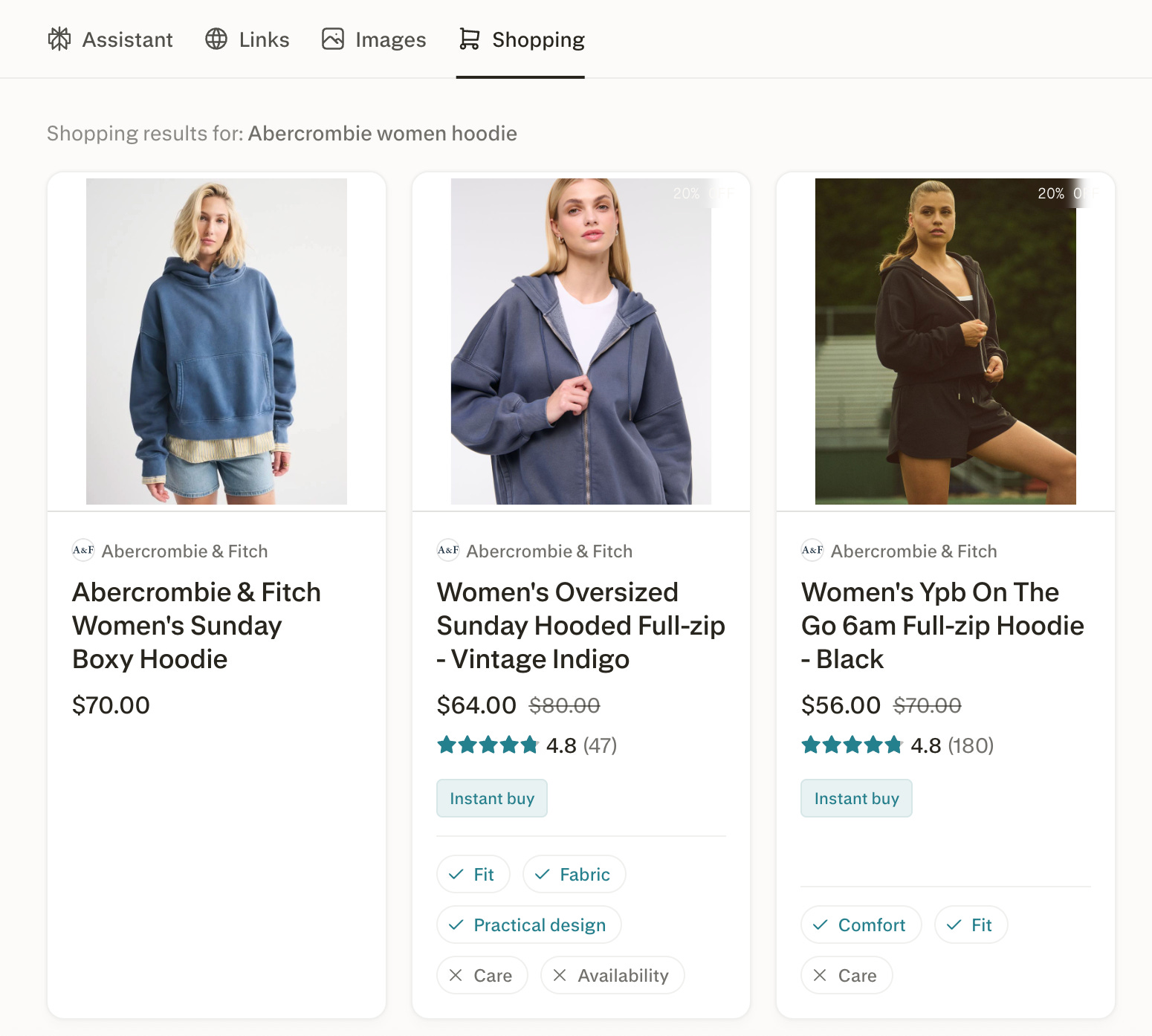
Example of a search prompt within Perplexity Comet showing product carousels with items that can be bought via “instant buy” and that can’t.
It is a helpful reminder that while the promise of agentic commerce is compelling, the current reality still lags behind. The infrastructure is still being built out, and the user experience and interface remain far from truly seamless or on par with established ecommerce standards.
Opportunity or Threat?
For businesses in the digital commerce space, agentic commerce represents either a significant opportunity or an existential threat depending almost entirely on your business model and how you respond.
Etsy has leaned in hard as a first-mover, and it appears to be paying off. ChatGPT now reportedly drives more than 20% of Etsy’s referral traffic, albeit from a still small overall base. Shopify’s CEO has been publicly enthusiastic. These companies see agentic commerce as complementary: a new discovery channel that brings high-intent customers to their merchants.
Amazon has taken the opposite view. It’s blocked dozens of AI bots from major companies, sued Perplexity over agent access, and is building proprietary alternatives it can control. This makes strategic sense: Amazon controls roughly 40% of US e-commerce and generates around $56 billion annually from advertising built around shoppers browsing Amazon.com. If AI agents mediate purchases without consumers ever visiting the site, that advertising model collapses. As Jordan Berke, CEO of Tomorrow Retail Consulting, put it, Amazon faces a “leader’s dilemma“. Their dominant market share means they have the most to lose.
The warning from BCG is stark: “Without swift intervention, retailers risk being sidelined and reduced to mere background utilities in increasingly agent-controlled digital marketplaces.”
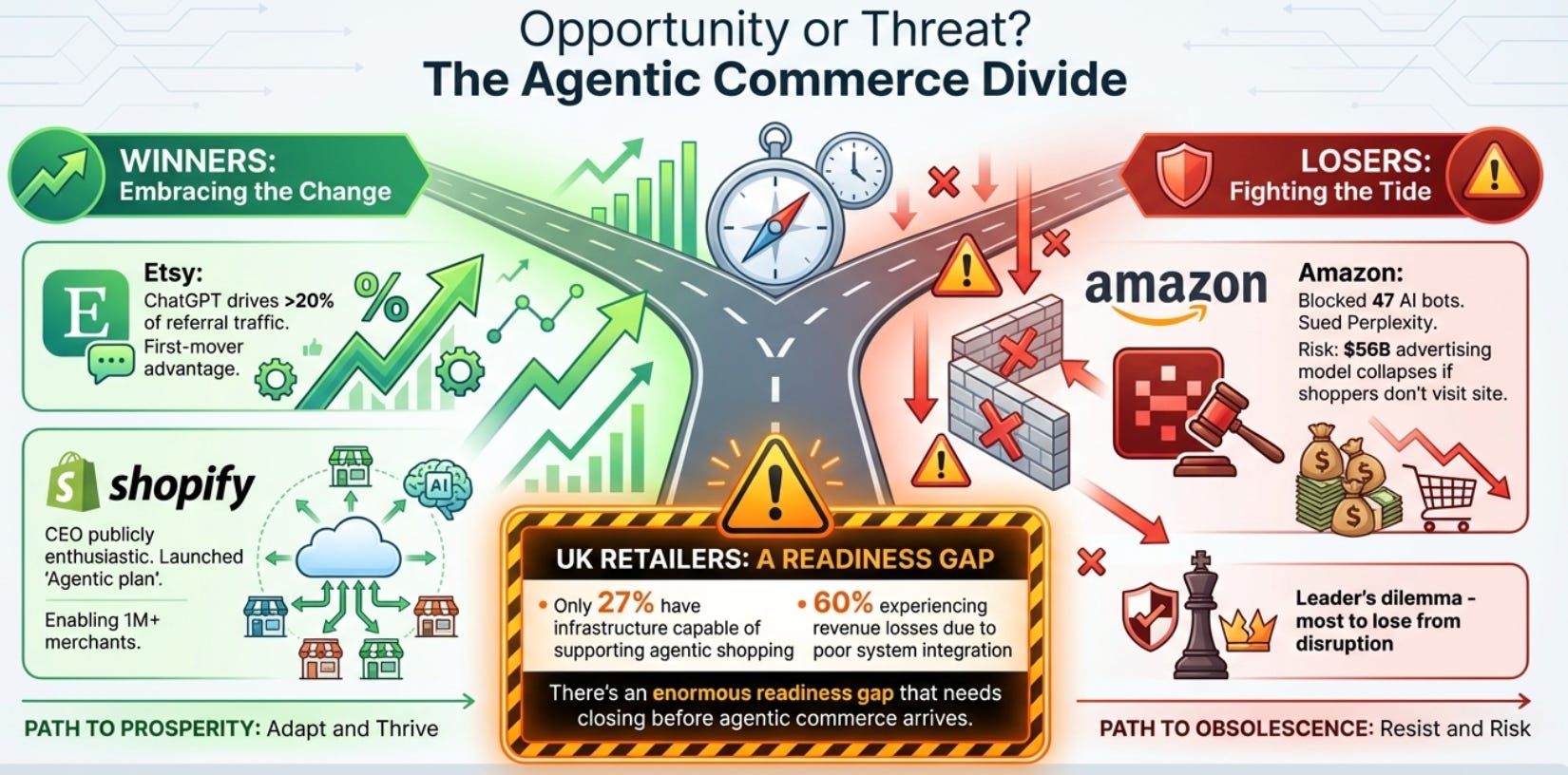
And UK retailers have a particular reason to pay attention. A recent Patchworks survey of 200 UK retail technology leaders found that only 27% have technology infrastructure capable of supporting agentic shopping, with 60% experiencing annual revenue losses due to poor system integration. There’s an enormous readiness gap and it needs closing before agentic commerce arrives on this side of the Atlantic.
The Future of Interfaces: Designing for Agents
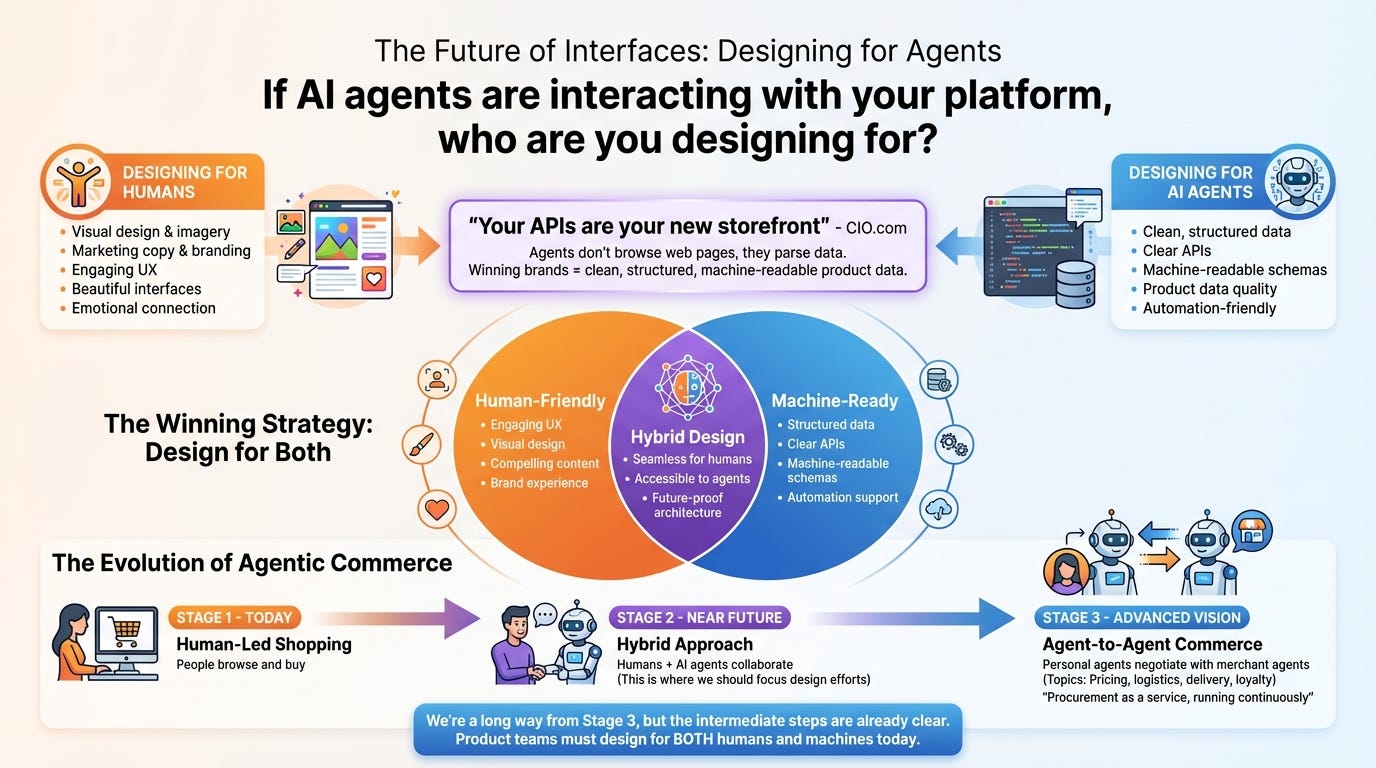
This raises a genuinely fascinating question for anyone building digital products: if AI agents are increasingly the ones interacting with your platform, who are you actually designing for?
The implications are significant. As one CIO.com analysis put it: your APIs are your new storefront. Agents don’t browse web pages, they parse data. The winning brands won’t be the ones with the best imagery or marketing copy; they’ll be the ones whose product data is clean, structured and machine-readable enough for an AI agent to understand and act on.
For now, a hybrid approach makes the most sense. Product teams should be designing for both humans and AI agents engaging UX and visual design for people; structured data, clear APIs and machine-readable schemas for the machines.
McKinsey’s most advanced vision describes a world where personal agents negotiate directly with specialised merchant agents across pricing, logistics, delivery and loyalty. Procurement as a service, running continuously in the background. We’re a long way from that today, but the intermediate steps are already clear.
The Future Commerce: What else changes
If agents become the primary interface, the value may shift away from traffic aggregation and toward transaction orchestration. Margins could migrate from marketplaces and ad platforms toward payment rails, protocol layers, and AI intermediaries.
In an agent-mediated world, brand preference may need to be encoded into data rather than communicated through storytelling. Loyalty programs, structured attributes and explicit customer signals may become more important than homepage aesthetics.
The next evolution could see individuals deploying their own autonomous agents. Imagine, instead of visiting a platform like ChatGPT to make a purchase, your personal agent could roam the web, querying product catalogs and handling transactions end-to-end. It’s a glimpse of a near-future marketplace where humans just set intent and oversight , the rest is handle by the agent/s.
If that future materialises, the implications are profound. Platforms could be partially disintermediated as the locus of value moves from traffic aggregation to orchestration and protocol control. Strategic moves such as OpenAI’s hiring of the OpenClaw founder suggest an awareness of this dynamic: when interfaces dissolve, owning the agent layer may matter more than owning the destination.
Trust: The Last Barrier
The technical foundations for agentic commerce are largely in place. The protocols exist. The payments infrastructure is being built. The AI models are capable enough. So what could stand in the way as these capabilities roll out globally?
Trust.
Forrester’s March 2025 Consumer Pulse Survey found that only 24% of UK online adults trust AI agents to act on their behalf to make routine purchases. That’s not for high-stakes decisions, that’s for everyday, low-risk buying. The barriers? Privacy concerns and a lack of transparency about whether consumers are even communicating with an agent in the first place.
Interestingly, the picture is almost identical in the US, where the same 24% trust figure was recorded. Globally, consumers want accuracy above all else. 79% say it’s the most important quality in AI-powered shopping (Contentsquare). They want to review purchases before they go through. They want to speak to a real person when something goes wrong. As Julie Geller, Principal Research Director at Info-Tech Research Group, has observed, the biggest barrier is “psychological, not technical”. Trust will build gradually, “one transparent, well-handled decision at a time.”
Security concerns compound this further. Among financial institution leaders, 78% expect fraud will increase significantly due to agentic commerce (Accenture). Visa has reported a 25% increase in malicious bot-initiated transactions globally. The emergence of AI agents creates entirely new fraud vectors that the industry is still learning to address.
When agents shop, fraud teams lose behavioural signals like mouse movements, browsing patterns and typing rhythm, making first‑party fraud harder to detect. At the same time, attackers are already building counterfeit “best deal” sites tuned to agent logic, and Visa is seeing a sharp rise in dark‑web chatter about tools designed to exploit AI shopping agents.
As AI moves from being a “tool” we talk to into an “agent” that acts on our behalf, a lot more work is required to build the infrastructure to ensure those actions remain safe, legal, and aligned with human interests. This requires that we address the “governance gap”.
And yet, there’s a fascinating contradiction in the data. While only 24% of UK consumers trust agents to buy for them today, 35% believe that in a future world where consumers use AI agents for purchase decisions, brands will market directly to those agents. In the US, that figure rises to 43%. Consumers can see where this is heading even if they’re not personally ready to hand over the reins just yet.
History Has a Way of Repeating Itself
It’s worth remembering that every major shift in commerce has started with exactly this kind of scepticism. Entering your card details into a browser once felt reckless. Mobile checkout, contactless payments and high‑ticket online purchases all followed the same trust curve: early resistance, gradual adoption, then sudden normality.
Agentic commerce is now at that “late‑90s e‑commerce” stage – limited integrations, clunky first‑generation experiences and a widespread belief that people will never really trust agents to buy for them. For senior digital and product leaders, the signal isn’t the hype but the direction of travel: agents are beginning to mediate high‑intent demand, and today’s rough edges are the worst this technology will ever be.
The question for merchants or brands is no longer whether agents will shop. It is whether your business will be legible to them when they do. The buyer may soon be software and so the brands that win will be those that machines can understand..
Stay tuned!
CxAI Team
So insightful and fascinating 🙌
Thanks for the feedback Chris! Glad you liked it.